
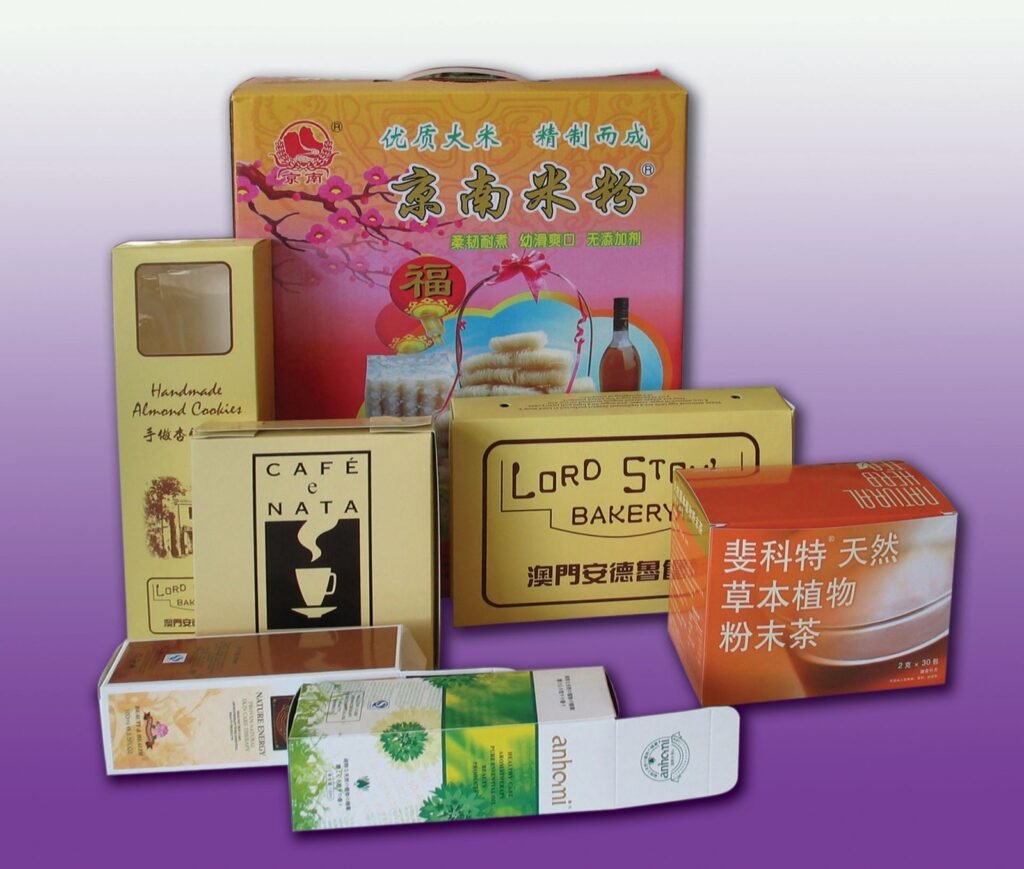
Choosing a folding carton is not simply a matter of selecting a shape that looks attractive. The carton must fit the product, support the required packing process, present the brand clearly and remain practical to manufacture. Two boxes with similar outside dimensions may behave very differently if their closures, bottom structures or board specifications are different.
This guide compares common folding carton box styles and explains how product weight, dimensions and packing method influence structure selection. It is intended to help buyers prepare a clearer request before asking a packaging supplier for a dieline, sample or quotation.
A folding carton is normally used as retail, primary or secondary packaging. If the package must carry substantial shipping loads, a corrugated transport box may also be required.
Start with the Product, Not the Box Name
Before comparing structures, record the product’s length, width, height and packed weight. Include any inner tray, bottle, pouch, insert, instruction leaflet or protective component that will sit inside the carton. The outer dimensions alone do not show how the load will be distributed.
The packing process matters as well. A carton packed manually in small batches may favour a simple and flexible structure. A project with a faster packing line may justify a pre-glued bottom that opens quickly. Display requirements, tamper-evident seals, hanging features and windows can further affect the dieline.
Board grade is a separate decision. A strong closure cannot compensate for paperboard that is unsuitable for the product. See our guide to paperboard thickness for folding cartons for the relationship between GSM, caliper and practical box performance.
Folding Carton Dimensions: What to Mark on Your Drawing
Send length × width × height with the unit, and state whether the measurements describe the product, the inside of the assembled carton or its outside. Mark each direction on a sketch instead of relying on the order of three numbers alone. Include the cap, pump, insert or other components that will be packed inside.
If you have an existing box, provide photos of the assembled pack and the opened carton, plus its dieline if available. Do not add an assumed clearance or convert outside dimensions into a production dieline yourself. We need to review the board, folds and product fit before confirming the finished dimensions. Confirm the fit with a physical sample before approving production.
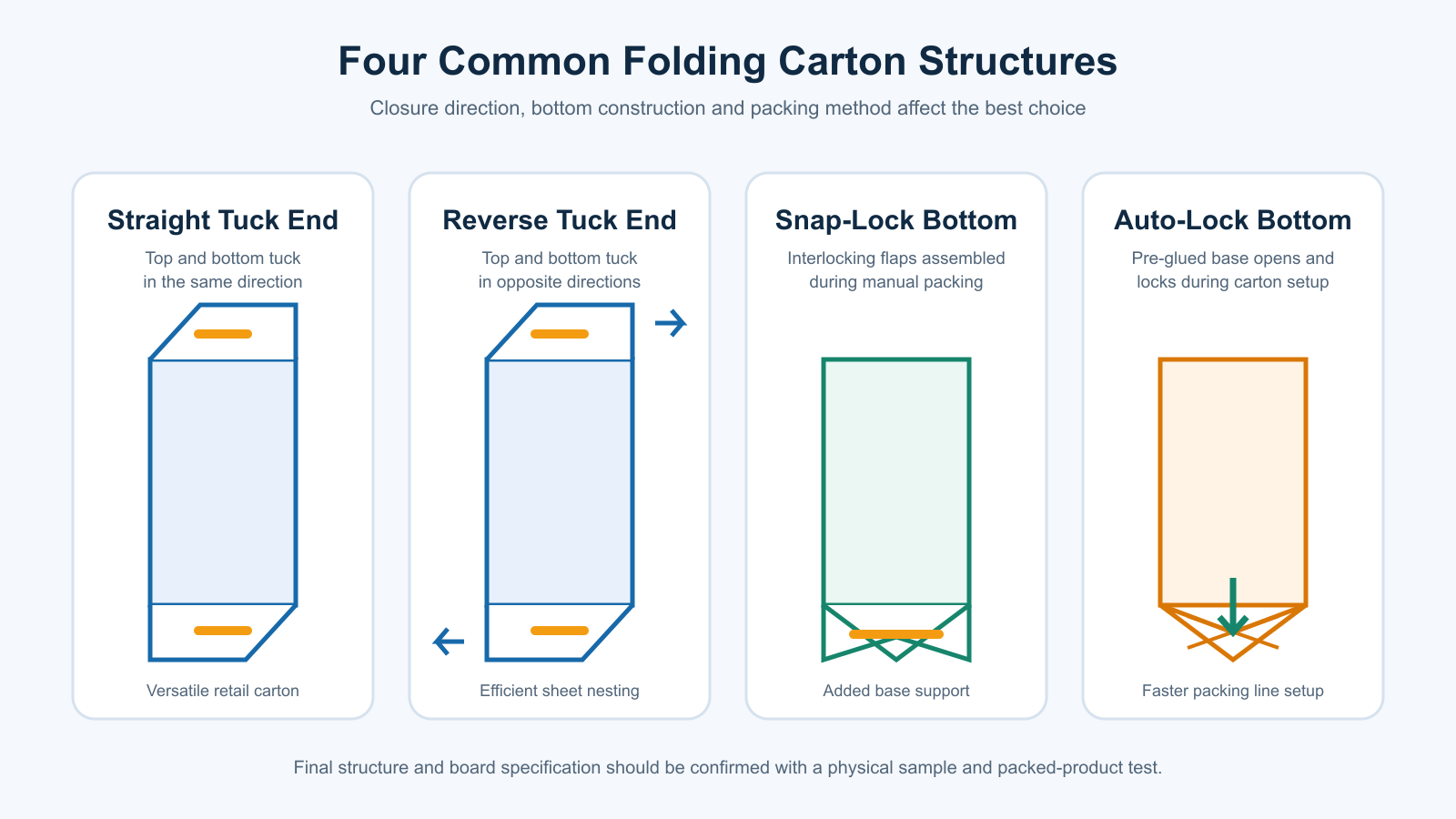
Straight Tuck End (STE)
A straight tuck end carton has top and bottom tuck flaps that close in the same direction. This arrangement often provides a clean front presentation because the main closure panels can be positioned consistently. It is widely used for cosmetics, personal-care products, light food items, small electronics and other retail packs.
STE is easy to understand and can work well for manual packing. However, it should not automatically be described as a heavy-duty box. Its performance still depends on the board, dimensions, product distribution and closure details. If the product could push against the ends, the supplier may recommend additional locking tabs, inserts or another bottom style.
Choose STE when a conventional retail presentation, straightforward opening and efficient manual packing are priorities. Confirm which panel will face the shelf before artwork begins, because the seam and tuck orientation affect the visible layout.
Reverse Tuck End (RTE)
On a reverse tuck end carton, the top and bottom flaps tuck in opposite directions. This layout can nest efficiently on a printed sheet and is common for general retail packaging. RTE and STE can appear almost identical when closed, but the direction of the tuck flaps and the placement of the glue seam differ.
RTE is often suitable for relatively light products that do not require a reinforced base. It may offer an economical starting point, but material utilisation depends on the exact dimensions and dieline. Buyers should therefore compare the complete quotation rather than assuming that RTE will always use less paperboard.
It is important not to confuse tuck orientation with board strength. “Reverse tuck end” describes how the ends close; it does not identify the paperboard grade, thickness or load capacity.
Snap-Lock Bottom (1-2-3 Bottom)
A snap-lock bottom, also called a 1-2-3 bottom or manual lock bottom, uses several flaps that interlock during carton setup. It generally provides more bottom support than a simple tuck-end closure and can be considered when the product needs a more secure base.
The trade-off is packing time. An operator must fold the bottom panels in the correct sequence before loading the product. This can be practical for small or medium runs, especially when packing is manual, but the labour requirement should be considered for larger volumes.
Snap-lock cartons are used for products such as bottles, jars, hardware and other items where a simple tuck bottom may not be preferred. The actual suitability must still be tested using the finished product. A heavy item concentrated in one small area may require an insert, stronger board or a different packaging system.
Auto-Lock Bottom (Crash-Lock Bottom)
An auto-lock bottom carton has a pre-glued base that opens and locks into position when the flat carton is erected. It can reduce setup time and make packing more consistent, which is useful when production efficiency is important.
This structure is commonly evaluated for moderate or heavier contents, bottled products and higher-volume packing. It normally involves additional converting and gluing compared with a basic tuck carton, so unit cost, tooling and order quantity should be discussed with the supplier. The potential labour saving may offset part of the added carton cost, depending on the project.
An auto-lock base should not be treated as a universal weight guarantee. Ask for a physical sample and test it with the real product, insert and intended handling conditions.
Tuck Top vs Auto-Lock Bottom: Which Part Are You Comparing?
A tuck top describes the top closure; an auto-lock bottom describes the base. They are not mutually exclusive: a carton can have a tuck top and a pre-glued auto-lock bottom. When requesting a quote, specify both the opening you want and the bottom structure rather than treating these names as two complete alternatives.
Ask us to review the product weight, packing method and an assembled sample before selecting the base. The structures in this guide are reference options, not a promise that every size, material or closure combination is available. Production feasibility and any tooling requirements must be confirmed for your project.
Comparison of Four Common Structures
| Structure | Typical packing method | Relative bottom support | Setup speed | Key point to confirm |
|---|---|---|---|---|
| Straight tuck end | Manual or semi-automatic | Basic | Fast | Shelf-facing panel and tuck direction |
| Reverse tuck end | Manual or semi-automatic | Basic | Fast | Seam position and sheet layout |
| Snap-lock bottom | Mainly manual | More supportive than a simple tuck | Moderate | Correct flap assembly and labour time |
| Auto-lock bottom | Manual or higher-speed packing | Reinforced pre-glued base | Fast after erection | Gluing, cost and packed-product test |
These descriptions are a shortlist, not an engineering approval. Dimensions, board grain direction, coating, humidity, product weight and transport conditions can change the result.
Sleeve Boxes and Window Cartons
A printed sleeve is an open-ended component that slides over a tray, rigid box, container or grouped product. It can add branding and create an unboxing effect without covering every side. Because the sleeve is not normally a complete load-bearing carton, its fit must be matched carefully to the inner pack. Too tight and it may be difficult to assemble; too loose and it may move during handling.
A window carton is not one single box structure. A die-cut window can be added to several carton styles to show the product. The opening removes part of a structural panel, so its size and position must be considered during design. If a transparent window film is required, specify the material expectation and confirm production feasibility. Buyers should also consider whether the product needs protection from light, dust or direct contact.
Other possibilities include gable-top cartons, pillow boxes, hang-tab cartons and cartons with internal partitions. These may solve a particular display or handling need, but they should be selected only after the core product and packing requirements are clear. Our Paper Boxes page provides an overview of custom printed carton options.
How Product Weight and Packing Method Affect the Choice
For a light product packed by hand, an STE or RTE carton may be the simplest starting point. If the bottom needs more support but manual setup is acceptable, a snap-lock bottom may be considered. When fast erection is important, an auto-lock bottom can be evaluated.
Product weight alone is not enough. A tall bottle creates different stresses from a flat, evenly distributed item of the same weight. An insert can stabilise the product and reduce movement, while an oversized carton can allow impact during transport. The supplier needs to understand both the product and the complete packed configuration.
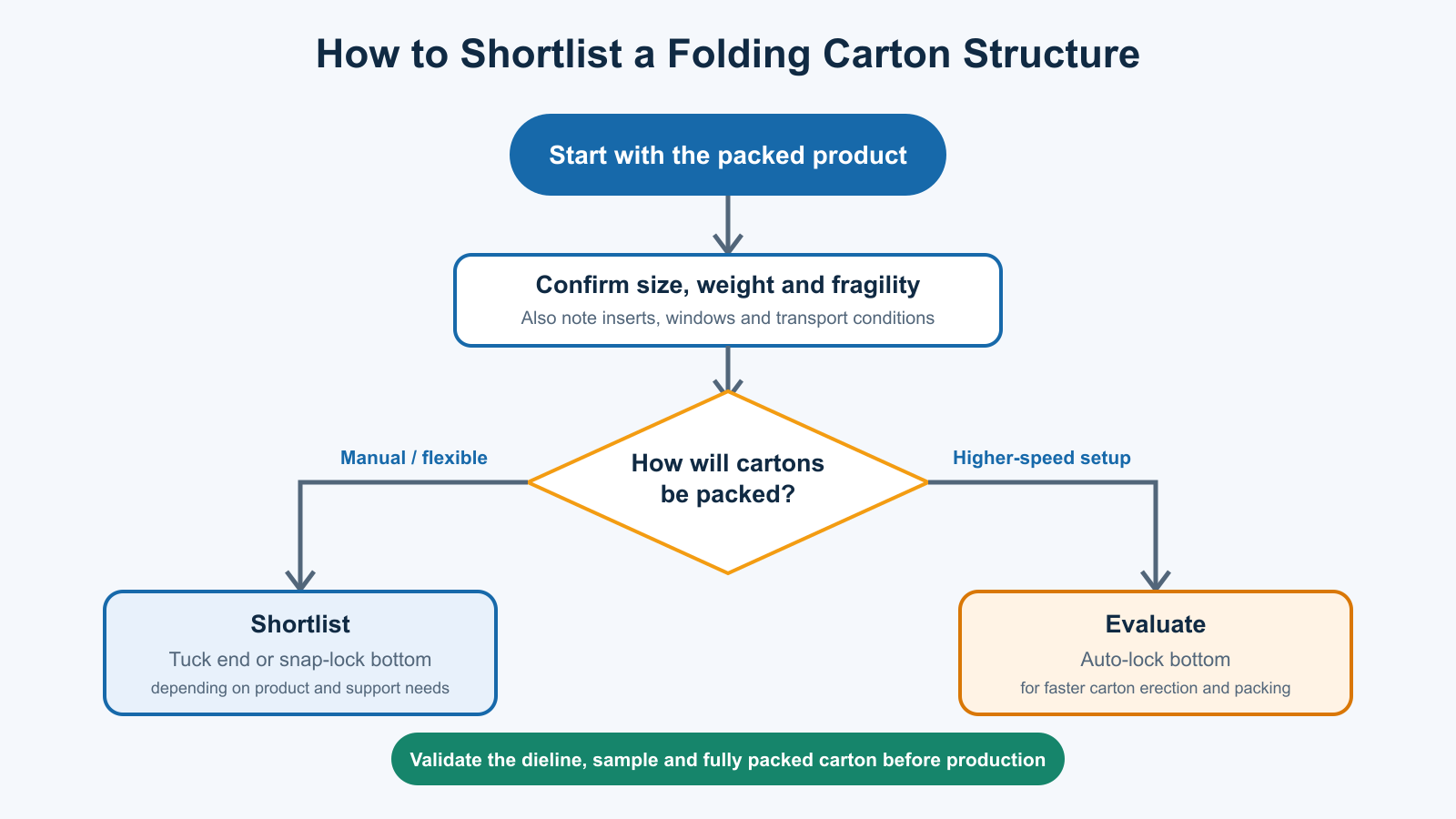
The chart is deliberately a shortlisting tool. Final approval should follow a dieline review, sample assembly and a trial using the actual packed product.
Information to Send Your Packaging Supplier
Provide the following information to obtain a more accurate recommendation and quotation:
- Product length × width × height and unit of measurement.
- Packed product weight and weight distribution.
- Clear product photos or a physical sample.
- Required order quantity and expected repeat volume.
- Manual, semi-automatic or automatic packing method.
- Preferred opening direction, display face and closure type.
- Any insert, window, hang tab or tamper-evident requirement.
- Artwork file, number of colours and required finish.
- Flat-packed or pre-glued delivery requirement.
- Destination and any known transport or storage conditions.
If the structure is not yet confirmed, share the product information first rather than forcing an existing dieline to fit. A supplier can then assess manufacturability through custom printing and converting and recommend a sampling route.
Sampling and Production Checklist
Before approving mass production, check the following points with a physical sample:
- The product fits without excessive movement or compression.
- All tuck flaps, locks and glue seams close correctly.
- The bottom remains stable when the filled carton is lifted and handled.
- The artwork orientation matches the intended shelf-facing panels.
- Barcodes, legal text and batch areas are positioned and readable.
- Windows, inserts and internal components align with the product.
- Operators can erect and fill the carton at an acceptable speed.
- The packed sample is tested under conditions relevant to storage and transport.
Digital samples can help confirm graphics and general dimensions, while a production-representative sample is more useful for checking material, printing and structure. Sampling method, cost and timing depend on the project. You can also review our factory and production capabilities when planning a custom order.
Request a Folding Carton Recommendation
The best carton structure balances presentation, product protection, packing efficiency and total cost. STE and RTE cartons suit many light retail products; snap-lock and auto-lock bottoms provide different approaches when greater base support or faster setup is needed. Sleeves and windows can add presentation value, but they must be integrated into the complete structural design.
For product-specific quotation requirements, see our custom printed paper boxes page and prepare the box dimensions, packed product weight, quantity and artwork.
Send us your product dimensions, packed weight, photos, quantity, artwork and packing method. Haosen Packaging can review the information, prepare a dieline or sampling proposal and help you shortlist a practical custom folding carton. Contact us for a folding carton quotation.