PETG shrink sleeve labels are widely considered for bottles and containers that need high-impact, 360-degree graphics and close conformity around curved or contoured surfaces. They can cover a large printable area, support reverse printing and create a smooth finished appearance when the film grade, artwork and shrink process are correctly matched.
However, PETG is not a complete production specification. Different PETG films can have different shrink curves, thicknesses, shrink forces and machine-direction behaviour. A buyer should therefore approve a specific film grade and a physical shrink result rather than ordering only by the material name.
This guide explains where PETG shrink sleeves may fit, which technical details affect the result and what information to send before requesting a sample or quotation.

What Does PETG Mean in Shrink Sleeve Packaging?
PETG is a glycol-modified copolyester used to produce clear heat-shrinkable film. In a typical shrink sleeve project, the artwork is printed on the film, the printed web is formed into a tube, the tube is cut or supplied on a roll, and the sleeve is placed over the container. Controlled heat then causes the film to shrink mainly around the container circumference.
The term PET is sometimes used loosely in commercial discussions, but PET and PETG should not be treated as identical specifications on a purchase order. If a project requires PETG, a crystallizable PET solution or another polyester shrink film, state that requirement clearly and request confirmation of the final grade.
Why Buyers Consider PETG Shrink Sleeve Labels
1. Coverage for contoured containers
Suitable PETG grades can provide the shrink response needed for bottles with pronounced shoulders, narrow necks, curved panels or a substantial change in circumference. This makes PETG a common candidate for personal-care, household, beverage and food packaging with more demanding shapes.
High shrink capability alone does not guarantee a good result. The film must shrink in a controlled sequence, and the artwork must compensate for the way the sleeve moves across different areas of the container.
2. Clear, glossy graphic presentation
PETG films are available with high clarity and gloss, allowing printed colours and graphics to remain visually strong. Reverse printing can place the ink inside the sleeve, where the film helps protect the printed surface during normal handling.
The finished appearance still depends on the printing process, white ink, colour management, surface finish and the opacity of the container or packed product. A transparent film on a clear bottle will not look the same as the same artwork on an opaque white container.
3. Large printable area
A full-body sleeve can use much of the container surface for branding, instructions and regulatory information. This can be useful when a conventional front-and-back label does not provide enough space or when several panels need to form one continuous design.
Important text, faces, barcodes and logos should not be positioned in the highest-distortion zones without technical review. The additional printable area must be planned around the seam, cut edges and container geometry.
4. Compatibility with several printing and application routes
Depending on the selected film and project, PETG shrink sleeves may be printed by gravure, flexographic, rotary offset or digital methods. Commercial PETG film portfolios also include grades intended for steam, hot-air or infrared shrink tunnels. This does not mean every grade works on every line. Film, ink, seaming system, container and tunnel conditions must be validated together.
PETG Is a Material Family, Not One Fixed Film
Two films described as PETG may perform differently. Before approval, confirm:
- the exact film grade and supplier specification;
- nominal thickness and permitted tolerance;
- transverse-direction shrink curve;
- machine-direction shrinkage or growth;
- shrink force, especially for thin-walled containers;
- surface treatment and ink compatibility;
- recommended storage conditions;
- seaming solvent or adhesive compatibility; and
- suitability for the intended shrink tunnel.
Avoid copying a film specification from another bottle without checking the new container. A grade that works well on a rigid cylindrical bottle may not be suitable for a thin-walled container with a steep shoulder.
Start with the Actual Container
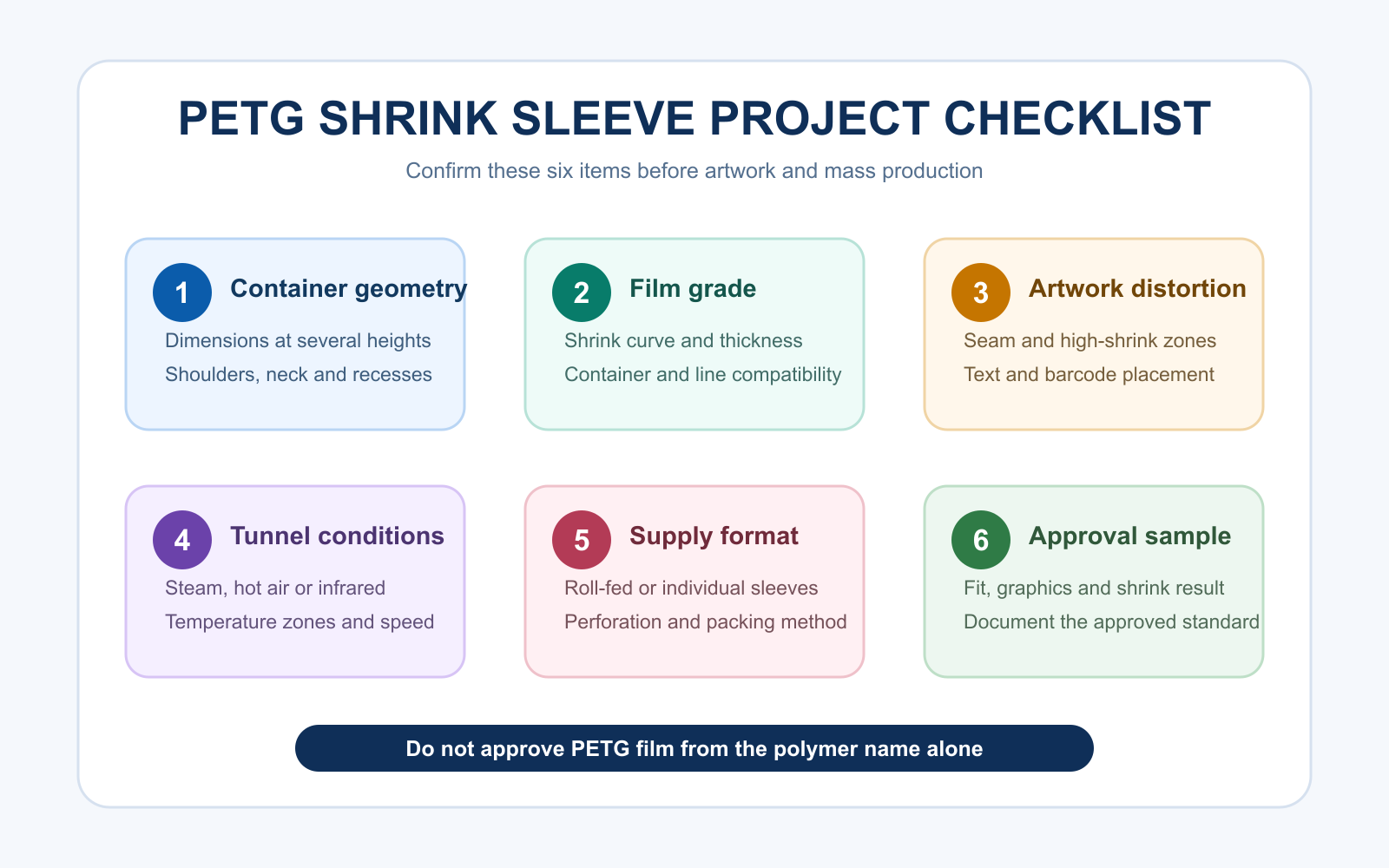
The container is the basis of the sleeve specification. Provide an accurate production drawing or a physical sample whenever possible. For a shaped bottle, measure the circumference or diameter at several heights rather than reporting only the maximum width.
Also confirm:
- container material and wall thickness;
- total height and the intended sleeve coverage;
- the shoulder, neck, base and any recessed grip areas;
- cap, pump or closure dimensions that affect application;
- whether the container is empty or filled during shrinking;
- product fill temperature and sensitivity to heat; and
- whether the sleeve will be applied manually or automatically.
Our guide on how to measure a container for custom shrink sleeve labels explains the measurement points and photographs needed for an initial review.
Plan Artwork for Shrink Distortion
Shrink sleeve graphics are not simply wrapped around a bottle at their final visible proportions. The artwork may need controlled distortion so that it appears correct after the film conforms to the container.
High-distortion zones are often located around shoulders, necks, corners and large changes in circumference. Keep barcodes, small regulatory text, fine borders and critical logos in more stable areas whenever possible. The seam should not pass through important copy unless the design has been reviewed for overlap and tolerance.
Final artwork should be prepared only after the container, layflat width, cut height, seam position, film grade and coverage area are confirmed. Changing the container or film after artwork approval can require a new distortion review and another shrink trial.
Match PETG to the Shrink Tunnel
Steam, hot-air and infrared tunnels transfer heat differently. Conveyor speed, tunnel zones, airflow or steam distribution, bottle rotation and the temperature of the filled product can all affect the result.
The goal is not simply to apply more heat. Heat must reach the correct areas in the correct sequence. Poorly controlled shrinking may cause wrinkles, uneven edges, graphic movement, trapped air, smiling or frowning at the sleeve edges, or excessive force on a lightweight container.
If an existing application line is available, provide its tunnel type, number of heating zones, normal speed and the material already running successfully. For a new project, a line trial using production containers is safer than approving only a flat printed proof.
Supply Formats and Optional Converting
Haosen Packaging can review projects requiring roll-fed tubular sleeves or individually cut sleeves. The suitable format depends on the application method, equipment and packing process. Optional converting can include perforation, easy-tear lines, vent holes and project-specific packing.
Visual options may include gloss, matte and holographic effects, subject to artwork, film compatibility and the intended application. These processes should be confirmed before sampling because they can affect cost, artwork preparation and production sequence.
Sleeve application and heat-shrink service can also be discussed where the container, product and packing arrangement are suitable. Send the actual container and application requirements for review rather than assuming the same service fits every product.
Sampling, MOQ and Production Lead Time
The correct sample route depends on what the buyer needs to approve. A digital sample can help check dimensions, content and general appearance. A gravure press sample is more representative of the intended production process but may require cylinders, setup and additional cost.
For current Haosen Packaging projects, indicative sampling cost is normally USD 100–400, with an estimated sampling time of 3–8 days, depending on the sample method, artwork readiness, quantity and technical requirements. These figures must be reconfirmed for the actual project.
Small custom orders can be reviewed, while larger volumes normally receive more favourable unit pricing. Minimum order quantity should be quoted together with the film, printing process, number of artwork versions, sleeve size and supply format. Our shrink sleeve label MOQ guide explains why a single MOQ does not apply to every job.
Normal production lead time is approximately 10–15 days after the final artwork, specification and approval requirements are confirmed. Shipping time is separate and depends on the destination and transport method.
Do Not Make a Recycling Claim from PETG Alone
The word PETG does not prove that the complete package is compatible with a particular recycling stream. Bottle material, sleeve coverage, film density, inks, coatings, perforation and local sorting systems all matter. High-coverage sleeves may also affect near-infrared sorting.
Conventional PETG and newer crystallizable PET shrink-label solutions should not be grouped together without checking the actual specification. If recyclability is a project target, identify the destination market and required design-for-recycling protocol at the quotation stage. The selected label construction may need sorting, washing, ink or separation testing before a claim is approved.
PETG, PVC or OPS?
PETG is often evaluated for complex shapes and higher shrink demand. PVC can remain practical for established, cost-conscious applications where market and customer requirements allow it. OPS may suit particular low-shrink-force or application requirements. None is universally best.
For a material comparison, read PETG vs. PVC shrink sleeve labels. Final selection should still be based on the actual container, film data and shrink trial.
PETG Shrink Sleeve Enquiry Checklist
Send the following information for a more useful recommendation and quotation:
- Actual container or production drawing.
- Container material and packed product.
- Measurements in millimetres at several heights.
- Required sleeve coverage and clear photographs.
- Quantity per design and expected repeat volume.
- Editable artwork or current label files.
- Preferred supply format: roll or individual sleeves.
- Shrink tunnel type and application speed, if known.
- Finish, perforation and packing requirements.
- Destination country and any recycling or compliance target.
- Required sample type and approval date.
- Delivery address and target schedule.
Frequently Asked Questions
Are PET and PETG shrink sleeves the same?
No. The names are sometimes used loosely, but they should not be treated as identical purchase specifications. Confirm the exact film grade and required performance before production.
Is PETG suitable for every shaped bottle?
No material can be approved from a photograph alone. PETG is commonly considered for contoured bottles, but suitability depends on the film grade, container geometry, wall strength, artwork and tunnel settings.
Can PETG sleeves be supplied on rolls and as individual pieces?
Yes, both formats can be reviewed. The correct format depends on the sleeving equipment, manual or automatic application method, sleeve dimensions and packing process.
Can you add matte, holographic, vent-hole or easy-tear features?
These options can be reviewed, including matte, gloss, holographic effects, vent holes and easy-tear perforation. Final feasibility depends on the film, artwork and converting specification.
Should I approve a digital sample before production?
A digital sample is useful for checking content and general size, but it may not reproduce the exact production print, film shrink behaviour or special finish. Agree in advance whether the project requires a production-representative sample or line trial.
Request a PETG Shrink Sleeve Review
Send your container photographs, dimensions, artwork, quantity, application method, destination country and delivery requirements. Haosen Packaging can review the project and identify the next sampling step before mass production.
Request a PETG Shrink Sleeve Quote or explore our full range of custom shrink sleeve labels.
Technical note: final performance depends on the selected film manufacturer’s data, approved artwork, production trials and destination-market requirements.