
Surface finishing changes how a printed paper box looks, feels and performs. It can make colours appear deeper, protect printed areas from light handling, highlight a logo or create a more premium unboxing experience. However, every added finish also affects artwork preparation, sampling, production steps, cost and lead time.
This guide compares common paper box printing finishes, including matte and gloss lamination, varnish, aqueous coating, hot foil stamping, embossing, debossing and spot UV. It is designed to help packaging buyers shortlist suitable options before requesting a dieline, sample or quotation.
A finish should support the product, brand position and distribution conditions. The most expensive combination is not automatically the most effective one.
Separate Printing from Finishing
Printing places colour, graphics and information on the paperboard. Finishing is applied during or after printing to change the surface appearance, tactile effect or level of protection. A folding carton may use CMYK printing without a special decorative finish, or combine printing with one or more finishing processes.
The board itself also influences the result. The same coating can look different on coated paperboard, uncoated specialty paper or recycled stock. Before selecting a finish, confirm the carton structure and board specification. Our guides to paperboard thickness for folding cartons and folding carton box styles explain these related decisions.
Matte Lamination
Matte lamination applies a thin film with a low-reflection surface. It creates a smooth, restrained appearance and can help protect printed areas from scuffing and moisture encountered during normal handling. Dark colours and minimalist designs often use matte lamination to create a controlled premium look.
The surface may show fingerprints, rubbing or polishing marks depending on the film, ink coverage and handling conditions. A physical sample is therefore important, especially for large dark areas. Matte lamination can also reduce colour vibrancy compared with a high-gloss finish.
Matte lamination is often considered for cosmetics, personal-care products, gift packaging and premium retail cartons. If recycling or material-reduction targets apply, tell the supplier early because lamination adds another material layer and may affect the preferred construction.
Gloss Lamination
Gloss lamination produces a reflective surface that can make colours appear brighter and more saturated. It offers a smooth, wipeable finish and is frequently used for food, beverage, household-product and promotional packaging where strong shelf impact is important.
Reflections can make small text harder to read under direct lighting, and scratches may be more visible on some surfaces. Gloss should therefore be evaluated under the lighting conditions expected in stores or photography. It is suitable when colour intensity and a polished commercial appearance are priorities.
Aqueous Coating and Varnish
Aqueous coating is a water-based coating applied over printed sheets. It can provide gloss, satin or matte effects and light surface protection. Because it is normally applied efficiently during print production, it may be a practical option for many folding-carton projects.
Varnish is another clear coating available in different sheen levels. It may be applied overall or to selected areas, depending on the printing process and specification. Neither aqueous coating nor varnish should automatically be treated as equivalent to film lamination. Resistance to moisture, rubbing, chemicals and repeated handling depends on the exact coating, substrate, ink system and test conditions.
Buyers should describe the required performance instead of requesting only a generic “protective coating.” For example, state whether the carton will be exposed to refrigeration, oily products, frequent handling or transport abrasion.
Hot Foil Stamping
Hot foil stamping uses heat and pressure to transfer a metallic or pigmented foil through a custom die. Gold and silver are common, but other colours and effects may be available. Foil can highlight a logo, border, product name or small decorative element without covering the entire carton.
Foil stamping requires suitable artwork and tooling. Very fine lines, closely spaced details, folds and glue areas can create production problems. Large solid foil areas may behave differently from small accents, so the supplier should review the design before confirming feasibility.
Cost is influenced by the foil area, die size, number of foil colours, registration requirements, carton layout and order quantity. Avoid assuming that all gold effects are the same: printed metallic ink, cold foil and hot foil stamping have different appearances and production requirements.
Embossing and Debossing
Embossing raises a selected design above the paper surface. Debossing presses the design below the surface. Both create a tactile feature that can make a logo or graphic more noticeable without relying only on colour.
The effect depends on paperboard thickness, fibre behaviour, coating, die design and the size of the artwork. Extremely fine details may not form cleanly, while deep embossing near scores or edges can affect folding. Registered embossing must align with printed or foiled artwork and requires tighter production control than a blind emboss with no printed alignment.
Embossing is commonly combined with matte lamination or foil stamping for premium cartons. The combination should remain selective; applying too many competing effects can reduce visual clarity and add unnecessary converting steps.
Spot UV
Spot UV applies a high-gloss cured coating to selected areas. It creates contrast when used over a matte background and can highlight a logo, pattern, image or product name. The strongest visual effect often comes from the difference in sheen rather than from covering a large area.
Accurate registration is important. Fine text, narrow lines and artwork near folds need technical review. The base surface must also be compatible with the coating system. A supplier may request a separate spot-UV artwork layer and recommend minimum line or gap dimensions based on the equipment and substrate.
Spot UV is decorative and should not be described as a universal barrier coating. If the project requires specific abrasion, moisture or chemical resistance, define and test those requirements separately.
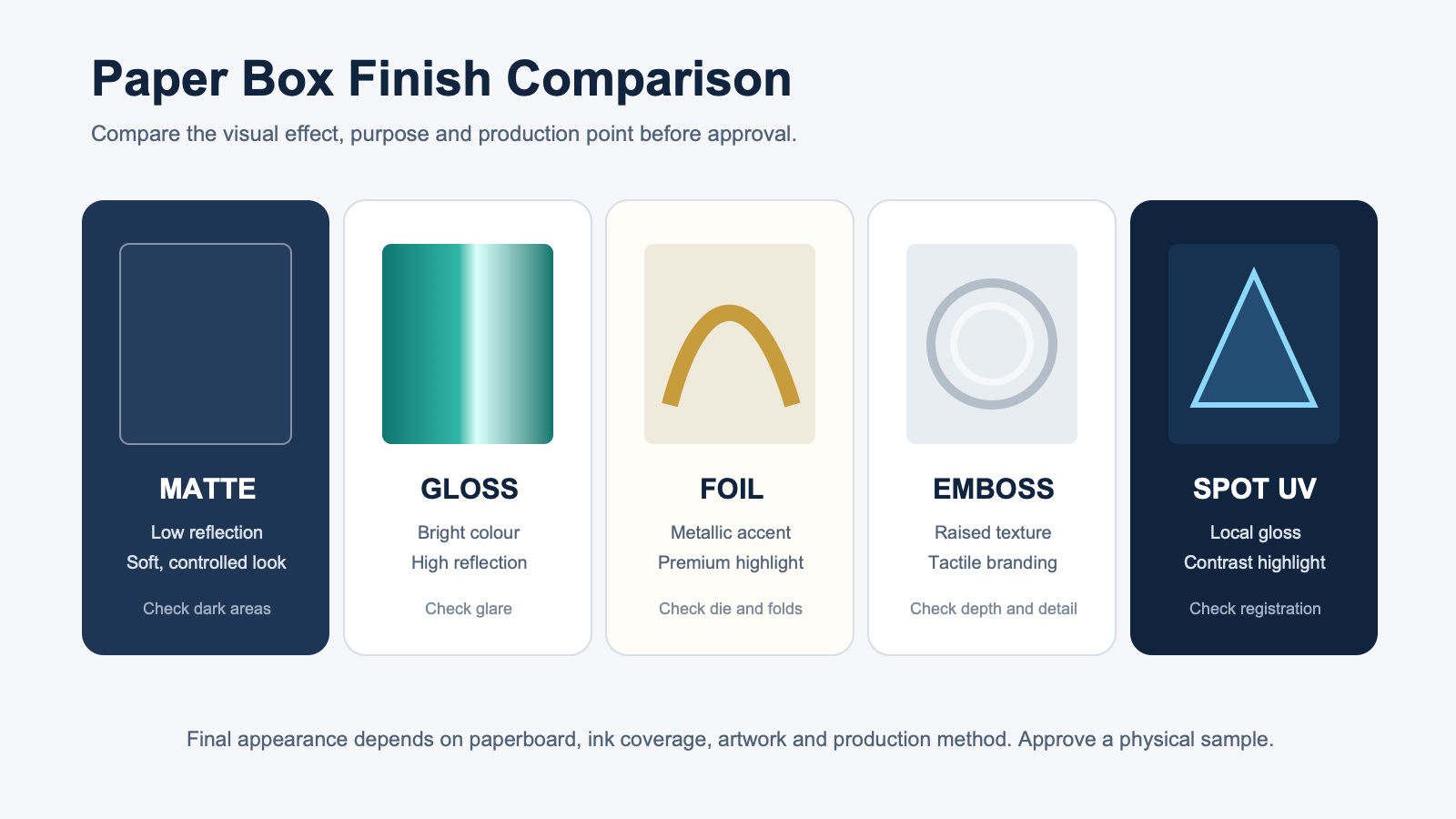
Quick Comparison of Common Finishes
| Finish | Main visual or tactile effect | Typical reason to use it | Important point to confirm |
|---|---|---|---|
| Matte lamination | Low sheen, smooth touch | Restrained premium appearance | Fingerprints, scuffing and recyclability requirements |
| Gloss lamination | Bright colour and high reflection | Strong shelf impact | Glare, scratches and lighting conditions |
| Aqueous coating | Overall protective sheen | Efficient general finishing | Required resistance and substrate compatibility |
| Varnish | Clear gloss, satin or matte effect | Overall or selected surface treatment | Coating type and performance expectation |
| Hot foil stamping | Metallic or pigmented accent | Logo or premium detail | Die, foil area, registration and fold positions |
| Embossing/debossing | Raised or recessed texture | Tactile branding | Detail size, depth and paperboard suitability |
| Spot UV | Localised high-gloss contrast | Highlight selected graphics | Registration, line width and base-surface compatibility |
The table is a shortlisting tool. Final specifications should be confirmed using artwork review and a physical sample representative of the intended production method.
Choosing a Finish by Product and Brand Position
For a clean premium cosmetic carton, matte lamination with a small foil or embossed logo may be appropriate. A colourful food or household-product carton may benefit from gloss lamination or an aqueous coating that supports strong printed colour. A natural or sustainability-led brand may prefer a carefully selected uncoated or lower-complexity surface, provided the required handling performance can still be met.
Retail lighting, e-commerce photography and consumer handling should be considered together. A highly reflective finish can attract attention on a shelf but create glare in product photographs. A soft matte finish may look refined but require additional evaluation for scuff resistance on dark artwork.
Do not select a finish from a digital screen alone. Monitors cannot reproduce texture, metallic reflection, embossing depth or the interaction between ink and paperboard.
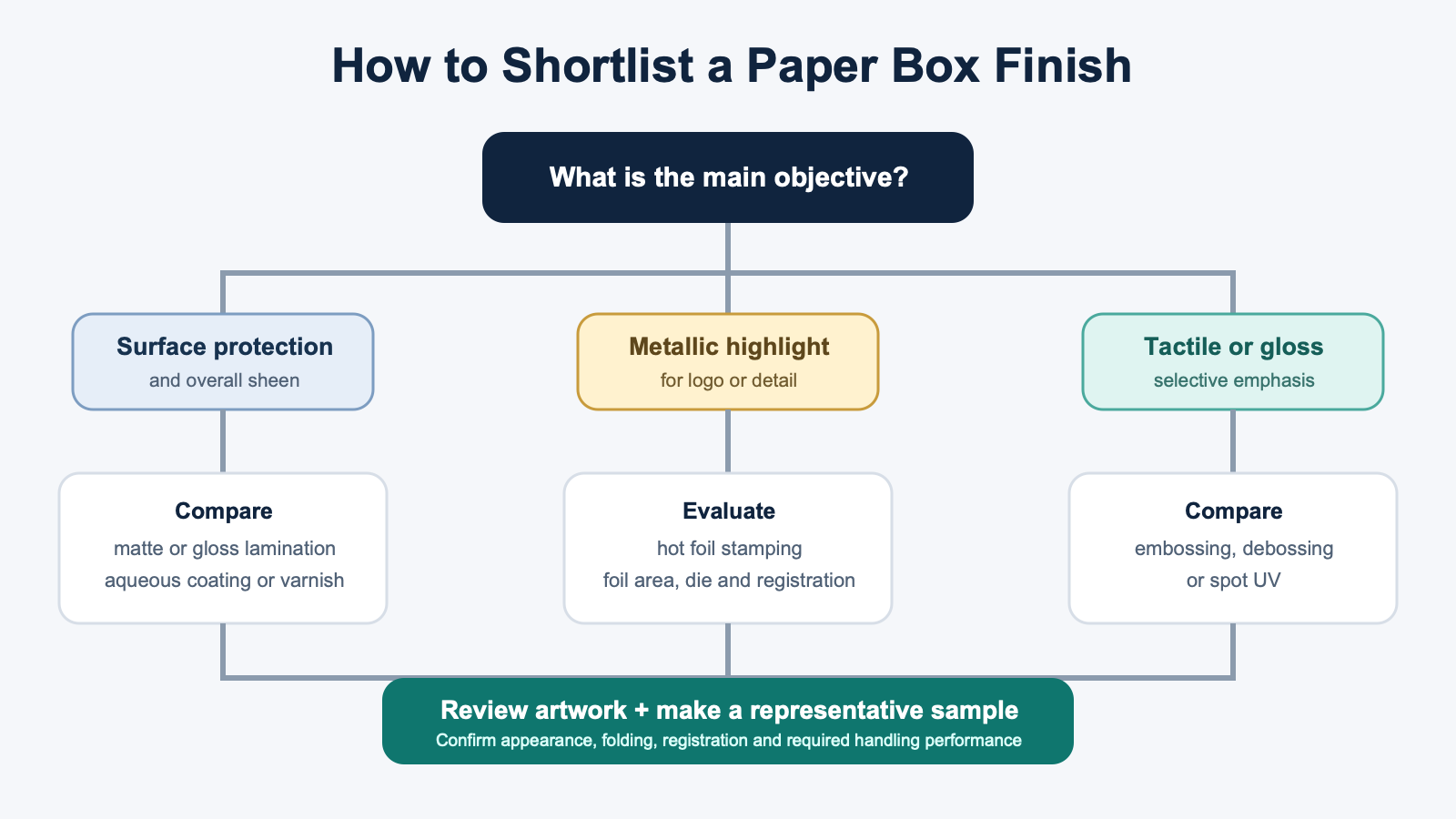
How Finishes Affect Artwork Files
Decorative finishes normally require clearly separated artwork layers. Use vector paths for foil, embossing and spot UV wherever possible. Name each layer clearly and do not represent a finish only with a colour that also appears in the printed artwork.
Confirm the supplier’s requirements for trapping, knockout, overprint, minimum line width and distance from scores, cuts and glue areas. Final artwork should be prepared on the approved dieline. Moving a panel, seam or tuck flap after finishing layers are created can cause alignment errors.
For custom printing and converting, provide the original editable artwork rather than only a low-resolution preview. A PDF can be useful for reference, but the production team may also require linked images, fonts converted to outlines and separate finish layers.
Sampling, Cost and Lead-Time Factors
A digital print sample can confirm general colour, content and dimensions, but it may not reproduce the exact result of foil, embossing, spot UV or production lamination. A production-representative sample may require tooling and additional setup.
Sampling cost and lead time vary with the number of processes, tooling, board, artwork readiness and quantity. Combining lamination, foil, embossing and spot UV creates more production stages and more registration checks. It can also increase the chance that a design needs adjustment before mass production.
Instead of asking for a fixed finishing price without specifications, provide the box dimensions, quantity, board, artwork and finish area. The supplier can then assess tooling, sheet layout and process sequence. Minimum order quantity also depends on the complete project rather than the finish name alone.
Finishing Approval Checklist
Before approving mass production, check:
- Colour and sheen under relevant lighting.
- Surface consistency on large solid areas.
- Foil coverage, edges and registration.
- Embossing or debossing depth and alignment.
- Spot-UV position and contrast.
- Scores, folds and glue areas after finishing.
- Barcode and small-text readability.
- Resistance required for packing, storage and distribution.
- Compatibility with any window, insert or adhesive.
- Finished carton appearance after assembly with the actual product.
Approval should use an agreed reference sample and documented tolerances. Decorative processes naturally involve manufacturing variation, so acceptable limits should be discussed before production rather than judged only after delivery.
Information to Include in Your Enquiry
Send the following details for a more useful recommendation and quotation:
- Product dimensions and packed weight.
- Carton size and approved dieline, if available.
- Paperboard type and thickness, if already selected.
- Order quantity and expected repeat volume.
- Printing colours and artwork files.
- Desired finish and approximate application area.
- Reference photos or physical samples.
- Required sampling method.
- Packing, storage and delivery conditions.
- Target delivery country and schedule.
If you are unsure which finish to choose, explain the desired appearance and performance instead. Haosen Packaging can review the box structure, artwork and production requirements before recommending a practical combination. Browse our custom paper box options or contact us for a paper box quotation.